 English
 Arabic
 French
 Spanish
 Portuguese
 Deutsch
 Turkish
 Dutch
 Italiano
 Russian
 Romaian
 Portuguese (Brazil)
 Greek
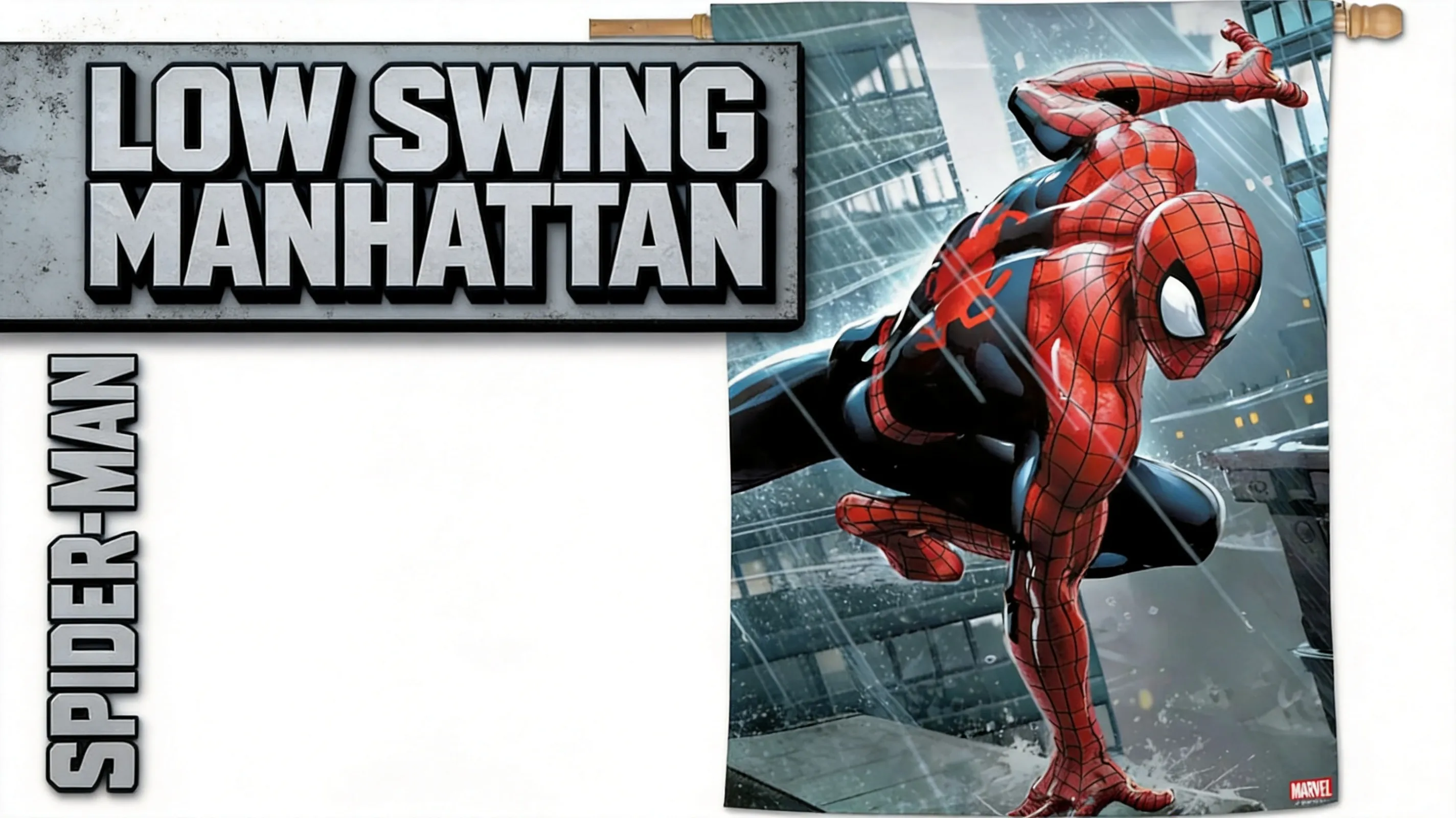
A perfect Manhattan line can still die at one bad corner: holding R2 starts a swing, but managing the pendulum arc is what turns Marvel's Spider-Man 2 web swinging into real speed. The current traversal meta rewards physics-based anchors, Web Wings, and momentum chains across Manhattan, Brooklyn, and Queens—not brute-forced routes. Treat every corner, tunnel, and river crossing as a link in the same speed chain.
Learn the Swing Arc Before Chasing Speed
Every web must attach to physical geometry—a building, tree, or crane—so a clean line starts with reading anchor placement. Maximum speed arrives near the bottom of the pendulum; the upper arc converts that speed into height. Set Swing Steering Assist to 0 if you want cleaner, physics-heavy control, but accept that the safety net against low collisions is gone.
Start with a L3 dive, hold R2 into a low arc, then release before the swing starts bleeding forward velocity. Short, low swings generate more forward speed than long, high arcs when your goal is crossing a street grid. If the arc feels dead, you attached too high or held R2 too long.
Turn Corners Without Killing Momentum
Use Corner Tethering instead of dragging the left stick through a wide turn: hold Circle while pushing the left stick toward a nearby building corner. Spider-Man whips around the edge and keeps the line alive. Watch for the white corner prompt and approach with enough height and lateral room for the tether to register.
Analog-stick-only turns work, but they bleed speed at intersections and force you to rebuild momentum. Veterans use the tether on 90-degree street-grid corners because it preserves the arc’s exit speed. If the prompt does not appear, you are too low, too close, or already past the corner.
Launch Faster With Dives, Loops, and Slingshots
Enter a fast L3 dive, keep R2 held, and circle the anchor to trigger a loop-de-loop; release near the bottom or peak for a super-kinetic burst. For vertical setup, hold R2 + X to charge a jump, then release X. For a standstill opener, L2 + X Slingshot Launch is the fastest option, especially before sparse-anchor crossings such as the East River between Manhattan and Brooklyn/Queens.
For neutral franchise context, Marvel's Spider-Man on Wikipedia helps separate the original game’s foundational swinging from Spider-Man 2’s Web Wings, Slingshot Launch, and expanded map traversal. The older kit still teaches pendulum timing; the sequel adds more recovery tools when anchors disappear. Use that context when comparing the 2018 foundation with the sequel’s traversal kit.
Build the Fastest Traversal Chain—and Pick the Right Edition
Chain movement instead of resetting it: Slingshot or L3 dive, low swing release, Spider-Dash (L1 + Triangle), Web Wings (Triangle), then wing-stream through wind tunnels for 2–3x glide speed. Air tricks (Square + stick) refill traversal resources, enabling more Dashes and Spider-Jumps (L1 + X) instead of letting a route stall. Keep the chain airborne: every release should feed a Dash, Wings, or a tunnel line.
| Step | Input | Best use |
|---|---|---|
| Slingshot Launch | L2 + X | Fast standstill opener |
| Low swing release | R2 then release | Forward velocity |
| Spider-Dash | L1 + Triangle | Mid-air burst |
| Web Wings | Triangle | Sparse anchors |
| Wind tunnel | Fly into green rings | 2–3x glide speed |
If you are comparing the current Spider-Man 2 PC and PS5 options after learning this traversal focus, check PriceRadar Marvel's Spider-Man tracker. The mechanics above are the current meta; the edition decision should follow your platform and performance priorities, not a brute-forced route. Pick the PC or PS5 edition that matches your platform, then let the traversal inputs above do the work.

