English
 Arabic
 French
 Spanish
 Portuguese
 Deutsch
 Turkish
 Dutch
 Italiano
 Russian
 Romaian
 Portuguese (Brazil)
 Greek

Sales professionals know that the moment a prospect agrees to review a pitch is precious. That window of attention can close quickly, and the material shared during it often determines whether a deal moves forward or quietly disappears. Yet many sales reps still spend hours preparing decks that end up looking generic, overloaded, or disconnected from the buyer's real concerns. A smarter approach is needed, one that saves time while making every pitch more compelling and personal. Slidyo offers that approach by combining AI-driven content creation with narrated delivery and detailed engagement insights.
Understanding What Buyers Actually Want
Before any slide is built, it helps to understand what modern buyers expect. Decision makers want clarity about their problem, confidence in the proposed solution, and a realistic sense of value and cost. They rarely have patience for long company histories or feature lists that ignore their specific situation. A strong pitch speaks directly to their challenges and guides them toward a logical decision. Keeping this buyer perspective at the center is the first step in creating material that feels relevant from the opening slide to the final call to action.
Starting With a Clear Story Structure
Every persuasive pitch follows a story, even if the audience never notices it. It begins with a recognizable problem, introduces the cost of leaving that problem unsolved, presents a solution, and closes with proof and next steps. When building a sales presentation with Slidyo, users can describe their offer and audience, and the AI drafts content that follows this kind of logical progression. This removes the guesswork from structuring a deck and gives sales reps a solid narrative backbone that they can refine with their own insights and customer knowledge.
Saving Time With AI-Generated Drafts
Time saved on preparation is time that can be spent on actual selling. Slidyo's ability to turn a simple description into presentation content means reps can produce a strong first draft in minutes rather than hours. They can then focus their attention on tailoring the message for a particular prospect, adding relevant case details, and sharpening the value proposition. For teams handling many opportunities at once, this efficiency adds up quickly, allowing them to respond faster than competitors and keep momentum alive throughout the sales cycle.
Letting the Deck Present Itself
One of the biggest challenges in sales is that decks are often forwarded to stakeholders who never attended the original meeting. Without the rep there to explain, these slides lose much of their power. Slidyo's AI narrates the presentation with natural voice, captions, and visual highlights, so every viewer gets the full explanation. A procurement manager or finance director reviewing the deck later hears the same clear message as the original contact, which helps maintain consistency as the deal moves through multiple hands inside the buyer's organization.
Answering Objections Before They Grow
Unanswered questions are one of the quietest deal killers in sales. A prospect may wonder about integration, pricing, or timelines and simply set the deck aside instead of asking. With Slidyo, viewers can pause and ask questions by voice or text, receiving answers based on the slides and any sources the rep has added. This turns potential objections into conversations at the exact moment they arise. It also gives the sales team visibility into what buyers are really concerned about, which is invaluable for follow-up discussions.
Tracking Engagement to Guide Follow-Up
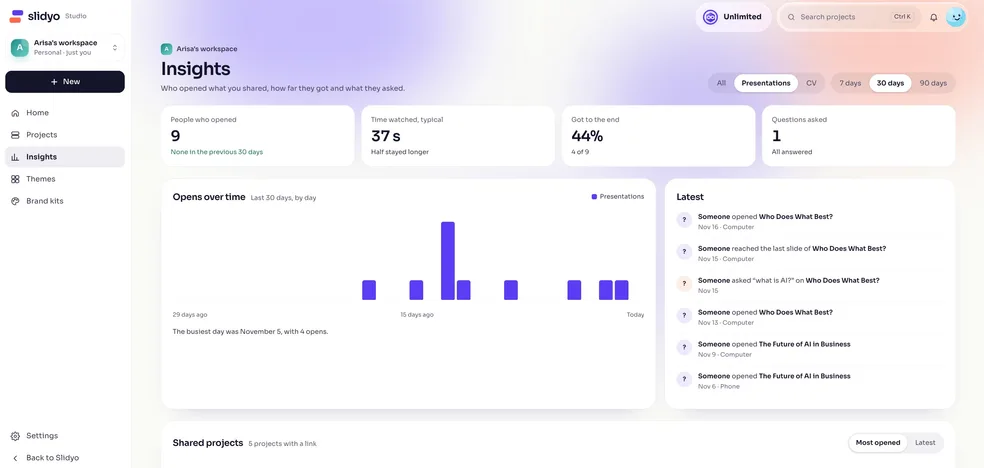
Knowing when and how a prospect engages with a deck changes the entire follow-up strategy. Slidyo shows who opened the link when an email is shared, how long viewers spent on each slide, where they stopped, and which questions they asked. If a buyer spent several minutes on the pricing slide, the rep knows to address cost directly. If they stopped halfway through, it may signal that a section needs reinforcement. These insights let sales teams follow up with precision instead of sending generic check-in messages.
Keeping Every Rep on Brand
In growing sales teams, consistency can easily slip as each rep adapts templates in their own way. Slidyo's team workspace allows shared themes, presentations, and a brand kit, ensuring that every pitch looks professional and aligned with company identity. Managers can build strong master decks that reps personalize without breaking the visual standard. This balance between flexibility and control helps organizations present a unified image to the market while still allowing individual reps to speak directly to their prospects' needs.
Turning Every Pitch Into a Repeatable Win
The real goal of any sales tool is to make success repeatable. By combining fast creation, narrated delivery, interactive questions, and engagement data, Slidyo helps sales teams learn from every deck they send. Patterns emerge over time, showing which messages resonate and which need improvement. Reps can start creating for free and gradually build a library of proven pitches. In a competitive market where attention is scarce, a presentation that explains itself, answers questions, and reports back on performance gives sales professionals a genuine edge.