 English
 Arabic
 French
 Spanish
 Portuguese
 Deutsch
 Turkish
 Dutch
Dutch
 Italiano
 Russian
 Romaian
 Portuguese (Brazil)
 Greek
Greek
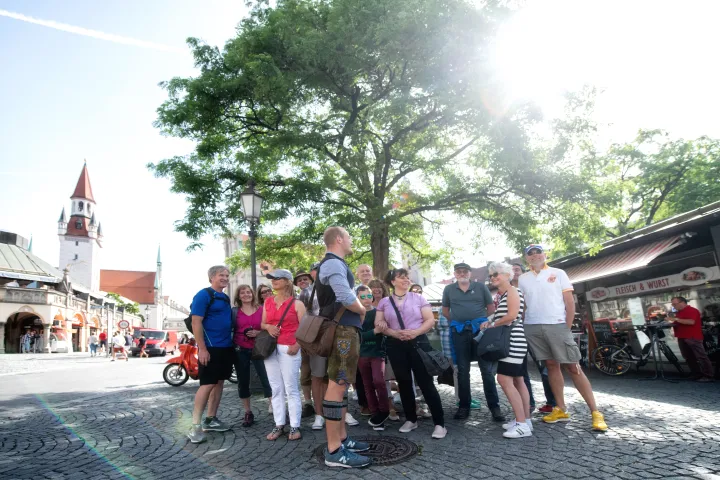
Why Munich's Old Town Demands Exploration on Foot
Munich's Altstadt — the historic old town at the heart of the city — is one of the finest walking districts in Central Europe, offering a concentration of architectural splendor, historical significance, and authentic urban life that rewards pedestrian exploration with constant discovery and surprise. The Munich Walking Tour experience that Radius Tours provides is specifically designed to unlock the old town's fullest potential, guiding visitors through the streets and squares of this remarkable district with the local knowledge, historical context, and storytelling skill that transforms a walk through beautiful old streets into a genuinely illuminating experience of European history and culture.
The Spatial Logic of the Altstadt
Understanding the spatial logic of Munich's old town makes navigation more intuitive and the walking experience more coherent. The historic city developed within a roughly oval ring of medieval walls, of which three gates — the Sendlinger Tor, the Isartor, and the Karlstor — survive as landmarks in the modern city. The main east-west axis runs through the pedestrian shopping zone along Kaufingerstrasse and Neuhauser Strasse, with the north-south axis connecting Marienplatz northward to Odeonsplatz and southward to the Sendlinger Tor. Most of the major old town landmarks are located within one or two blocks of these two axes, making navigation surprisingly straightforward for a first-time visitor.
The Street Network of the Medieval City
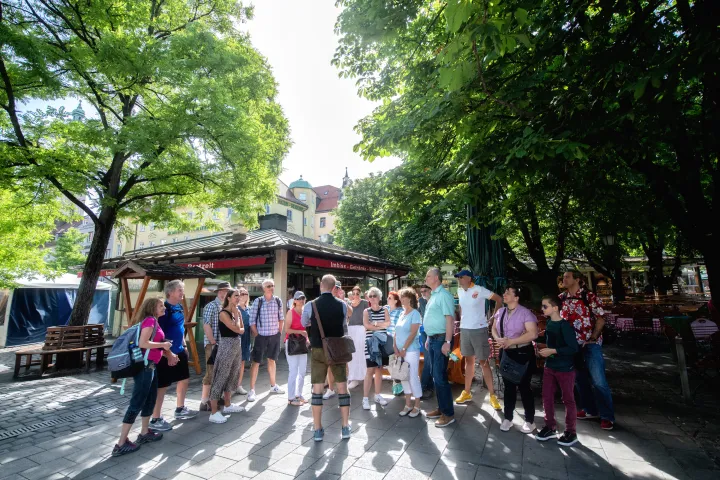
Walking the narrow streets that branch off the main axes of the old town reveals the persistence of the medieval street network beneath the later architectural overlays of baroque, neoclassical, and modern Munich. Streets like Weinstrasse, Theatinerstrasse, and Maximilianstrasse follow routes established in the medieval period, and the plots and building widths along these streets often reflect their medieval origins even when the buildings themselves are centuries newer. Walking these streets with awareness of their medieval dimensions and logic provides a different kind of historical connection than visiting the famous landmarks — a sense of the physical experience of moving through the city as it has functioned across time.
Marienplatz in Historical Depth
The history of Marienplatz extends across eight-and-a-half centuries of continuous use as Munich's central civic space, accumulating layers of historical significance that make every corner of the square worth examining carefully. The column that gives the square its current name has stood at its center since 1638, but before that date the square held a fish market, a grain market, and — in its darkest chapters — public executions. The Old Town Hall on the eastern side of the square contains one of the city's most macabre historical footnotes — a ballroom that was used by Nazi party members for a significant speech in the early years of the movement, and which now houses a toy museum.
The Streets Between the Churches
Some of the most rewarding walking in Munich's old town occurs on the streets between its famous churches, where the compressed urban fabric creates intimate spaces of considerable atmospheric quality. Rindermarkt, connecting the Viktualienmarkt to the area south of St. Peter's Church, retains the feel of a traditional market street despite extensive post-war reconstruction. Burgstrasse, running north from Marienplatz to the Alter Hof, Munich's oldest royal residence complex, passes through a series of spaces that maintain something of their pre-modern character. The Alter Hof itself — the courtyard residence of the Wittelsbachs before the expansion of the Residenz — is one of the old town's most charming and least-visited spaces.
The Alter Hof: Munich's Oldest Royal Site
The Alter Hof, tucked between Marienplatz and the main market streets, is Munich's oldest surviving royal site, with origins in the imperial court established here by Ludwig the Severe in the thirteenth century. The complex retains its distinctive bay window tower, the Affenturm — monkey tower — so named in memory of a legend involving a court monkey and the emperor's son. Today the Alter Hof houses a small museum dedicated to medieval Munich and is significantly calmer and less crowded than the nearby Residenz, making it one of the old town's most pleasant hidden discoveries for visitors who take the time to find it.
Evening in the Old Town
The old town's character changes significantly as the day progresses from the morning market activity through the midday tourist intensity to the more local atmosphere of the late afternoon and evening. The streets take on a warm amber glow in the early evening light that is particularly beautiful on the yellow-plastered facades of the baroque buildings. Restaurants fill with a mix of tourists and Munich residents, and the outdoor seating of the taverns along Tal and Frauenstrasse provides some of the city's most enjoyable people-watching. Walking the old town in the evening, with the day's historical learning as a framework for understanding what you are seeing, is one of Munich's most satisfying travel experiences.

